Table of Contents
If you’re planning to buy a home this year, one question probably comes up before anything else: what credit score do you need to get a mortgage in 2026? The honest answer is “it depends” — but not in a vague way. It depends on the loan program you choose, and each one has a clearly defined floor.
In this guide, we’ll break down the minimum credit score for a mortgage by loan type, explain why your score matters beyond just “yes or no” approval, and share practical steps to strengthen your number before you apply. Whether you’re a first-time buyer or refinancing, understanding the credit score needed for a mortgage is the first step toward a smoother approval process.
Why Your Credit Score Matters When You Buy a Home
Your credit score isn’t just a gatekeeper that decides whether you get approved. It also shapes:
- Your interest rate. A higher score typically unlocks a lower rate, which can save you tens of thousands of dollars over a 30-year loan.
- Your down payment options. Some programs let you put down less money if your score clears a certain threshold.
- Your mortgage insurance costs. Private mortgage insurance (PMI) and similar fees are priced based on risk, and risk is largely measured by your credit profile.
- Which loan programs you can even use. Some loan types simply won’t consider applications below a certain score.
In short, the credit score needed for a mortgage doesn’t just determine if you qualify — it determines how much the loan will cost you every single month.

Minimum Credit Score by Loan Type in 2026
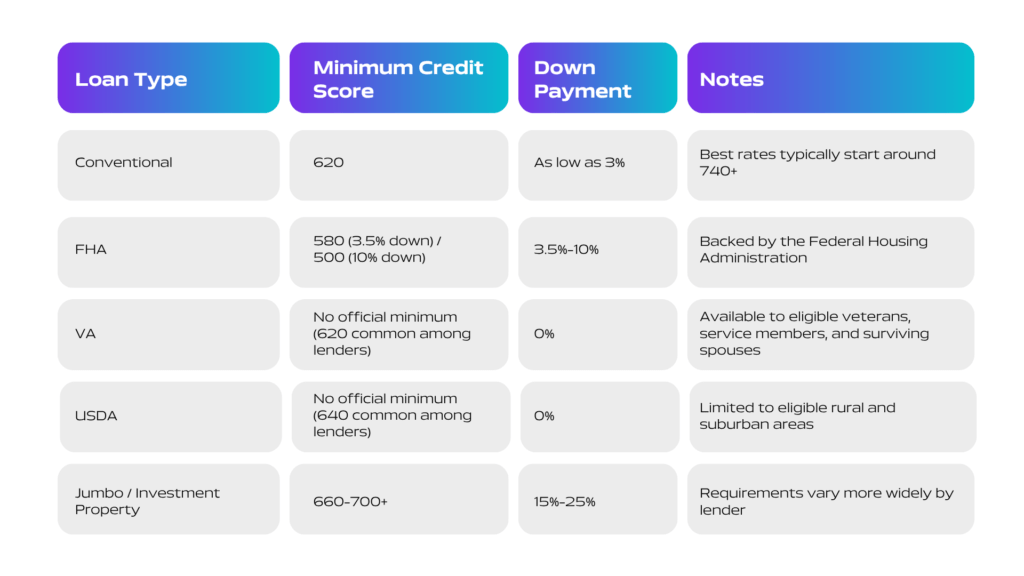
Here’s a quick-reference table showing the general credit score by loan type for the most common mortgage programs in 2026. Since the minimum credit score for a mortgage varies so much between programs, this table is the fastest way to see where you likely stand.
Keep in mind these are program minimums, not guarantees. Individual lenders can — and often do — set their own, stricter requirements on top of what the loan program technically allows.
Conventional Loans
Conventional mortgages are not backed by a government agency, so lenders lean more heavily on your credit profile to manage their risk. A 620 credit score is generally the floor for conventional financing, but borrowers who land in the 740-and-above range usually see the most competitive interest rates and the lowest private mortgage insurance premiums.
If your score falls below 620, a conventional loan probably isn’t on the table yet — but that doesn’t mean homeownership is off the table. It just means a different program might fit better right now, which is exactly why comparing the credit score by loan type matters before you rule anything out.
FHA Loans
FHA loans exist specifically to make homeownership more attainable for buyers who don’t have a high credit score or a large down payment saved up. That’s why the minimum credit score for a mortgage backed by the FHA drops as low as 580 if you’re putting down 3.5%, or even 500 if you can put down 10%.
This flexibility makes FHA loans a popular entry point for first-time buyers or anyone rebuilding their credit after a rough financial stretch. For many buyers, FHA is the answer to the credit score needed for a mortgage when a conventional loan isn’t realistic yet.
VA Loans
The VA itself doesn’t set an official minimum credit score, since these loans are backed by the Department of Veterans Affairs rather than underwritten purely on credit risk. In practice, though, most VA-approved lenders look for a score around 620. Combined with the option of a 0% down payment and no mortgage insurance requirement, VA loans remain one of the most cost-effective paths to homeownership for eligible borrowers.
Investment Properties and Jumbo Loans
If you’re buying a second home, an investment property, or financing above conforming loan limits with a jumbo loan, expect the bar to be higher. Lenders typically want to see scores in the 660–700+ range, plus stronger cash reserves and a lower debt-to-income ratio, since these loans carry more risk on the lender’s side.
How Lenders Actually Use Your Score
Loan officers don’t just look at a single number in isolation. They combine your credit score with your debt-to-income (DTI) ratio, employment history, and available cash reserves to get a full picture of your ability to repay. That means two buyers with the same credit score can get very different offers depending on the rest of their financial profile.
This is also why it’s worth getting pre-qualified early. A lender can tell you exactly where your credit score needed for a mortgage stands relative to the programs you’re interested in, and what specifically would move you into a better rate tier.
There’s no single credit score to get a mortgage that applies to everyone — the right number depends entirely on which loan program fits your situation. What matters most is knowing where you stand today, understanding which programs are realistically within reach, and taking a few targeted steps to strengthen your score before you apply. Even a modest improvement can translate into real savings over the life of your loan.

FAQS
It depends on the loan program. Conventional loans generally require at least 620, FHA loans can go as low as 500–580, and VA and USDA loans don’t have an official government minimum, though most lenders look for 620–640. In short, the credit score needed for a mortgage ranges roughly from 500 to 620 depending on which program you choose.
Yes, an FHA loan allows a 580 credit score with a 3.5% down payment. Below 580, you may still qualify with a larger down payment of around 10%.
Generally, yes. Lenders price risk into your interest rate, so a higher score typically results in a lower rate and lower mortgage insurance costs, though other factors like your down payment and DTI ratio also play a role.
Many borrowers see meaningful improvement within three to six months of consistent on-time payments and lower credit card balances. More serious issues, like collections or past bankruptcies, can take longer to fully recover from.
No. Checking your own credit score is considered a soft inquiry and does not affect your score. Only hard inquiries, like formally applying for a mortgage or another loan, can cause a small, temporary dip.
This content is for informational purposes only and does not constitute financial or legal advice. Loan terms and requirements vary by lender.